
Scotland County Release Records
A release from Scotland County Detention Center means that the sheriff's custody ended for a particular booking episode. It does not always mean unrestricted community release. A person may leave on bond, after time served, under a court order, or on probation. Another person may transfer to the North Carolina Department of Adult Correction, another county, federal authorities, or immigration custody. The destination and release type determine which public system should be checked next.
A local jail roster is built to show current confinement. Once staff process an exit, the name normally drops from that view. The sheriff keeps the booking and release record. The Clerk of Superior Court keeps the criminal case record. NCDAC maintains a separate prison and community-supervision history. Each record answers a different question, so a sound Scotland County released inmate lookup identifies the custody episode before interpreting the result.
- Release
- The end of one agency's custody for a specific booking or sentence.
- Discharge
- The recorded completion of custody or supervision under the controlling authority.
- Time served
- A sentence satisfied by custody already credited, once all other holds clear.
- Detainer
- A request or legal basis for another agency to take or continue custody.
Scotland County Release Paths
The release label matters as much as the date. Bond ends pretrial detention after the court's conditions are met, but the charge stays open unless the court later resolves it. Time served links the exit to a sentence or credit determination. A transfer closes the Scotland County jail episode while another agency takes over. Probation or post-release supervision places a person in the community under stated rules. A dismissal can end one charge but does not rule out another hold.
| Release path | What it means | Next record to check |
|---|---|---|
| Bond | Pretrial custody ends after release terms are met | Jail release record and eCourts case |
| Time served or court order | The jail acts on sentence credit or judicial authority | Jail timestamp and court judgment |
| Probation | A community sentence or supervised term may begin | Court judgment and NCDAC supervision status |
| NCDAC transfer | County custody ends, but state prison custody begins | NCDAC Offender Public Information |
| Other-agency transfer | A county, federal, or immigration custodian may receive the person | Receiving agency and transfer field |
Death or escape may also end ordinary roster presence, but neither should be called a routine community release. A blank current search cannot supply the missing event type. Ask for the recorded release authority and receiving agency whenever the destination is unclear.
Scotland County Bond Release Routes
The Scotland County Sheriff's bond policy identifies three local routes: bondsman, cash, and property. It states that a bondsman fee is typically 15 percent of the total bond. A property bond above $4,999 requires an attorney-prepared deed of trust. Jail staff should confirm the terms that apply to a specific order because the court, the bond form, and any other holds control whether release can be processed.
Bond-out answers only the custody question for that booking. It is not a dismissal, acquittal, or final judgment. After confirming the jail exit, use the court case number in the North Carolina eCourts Portal to follow later hearings and disposition. This two-source check prevents a release event from being mistaken for the end of the criminal case.
Scotland County Release Record Fields
A narrow request should identify one booking episode and ask for the fields that explain what happened. The local public portal shows admission data but suppresses its Releases interface, so the maintained sheriff record is more useful than trying to reconstruct an exit from a current list. Charges and bond describe the booking context. They do not replace the actual release date, type, authority, or destination.
| Field | What it shows |
|---|---|
| Name and identifiers | The person tied to the booking, subject to lawful redaction |
| Booking number | The specific Scotland County custody episode |
| Admit date and time | When the jail recorded entry |
| Release date and time | When the jail recorded the end of its custody |
| Release type or authority | Bond, court action, time served, transfer, or another basis |
| Receiving agency | Who took custody after a transfer, when maintained |
| Charges and bond | The booking and release-condition context |
| Booking photograph | The image tied to that booking, if disclosable and retained |
Does a release time prove the person is at liberty? No. It proves that Scotland County recorded the end of its custody. A receiving agency, detainer, or state sentence can explain why another custody record begins at about the same time.
Read the date beside the event label, not in isolation. “Bonded out” means a release condition was satisfied for that case. “Released by court order” identifies the authority but may not identify the destination. “Transferred” means the sheriff stopped holding the person because another custodian received them. “Time served” links the exit to credited custody, though added cases or detainers may still control. When the record is vague, ask whether the destination or receiving agency exists as a separate field instead of assuming a community release.
Request Scotland County Release Records
Scotland County publishes no special online release-record form, fixed copy charge, or promised response period. North Carolina's Chapter 132 calls for access as promptly as possible while allowing lawful redaction and withholding. A written request preserves the date range, requested fields, and response. Send county-jail requests to the Scotland County Sheriff's Office, not NCDAC. The state agency says it does not hold county-only jail files.
- Give the person's name, the approximate booking dates, and any known booking number.
- Ask for the existing admit and release timestamps, release type or authority, and receiving agency field.
- Request the booking photograph separately if needed, and ask for electronic delivery.
- Ask for advance notice of any fee. The county schedule does not list a release-record fee, but that does not guarantee no charge.
- If material is denied, ask for the legal basis and for any separable, nonexempt portion.
212 Biggs Street
Laurinburg, NC 28352
Main office: 910-276-3385
Jail: 910-277-3166 or 910-277-3168
Monday through Friday, 8 a.m. to 5 p.m.
The NCDAC Public Records portal is the separate route for a prison release or supervision file. Provide the OPUS number, facility, date range, and exact release-history fields. Basic conviction, sentence, admission, time-served, and release dates are generally available, while much of the internal offender file remains confidential.
The official NCDAC request page shows the state channel used when OPI does not resolve the record.
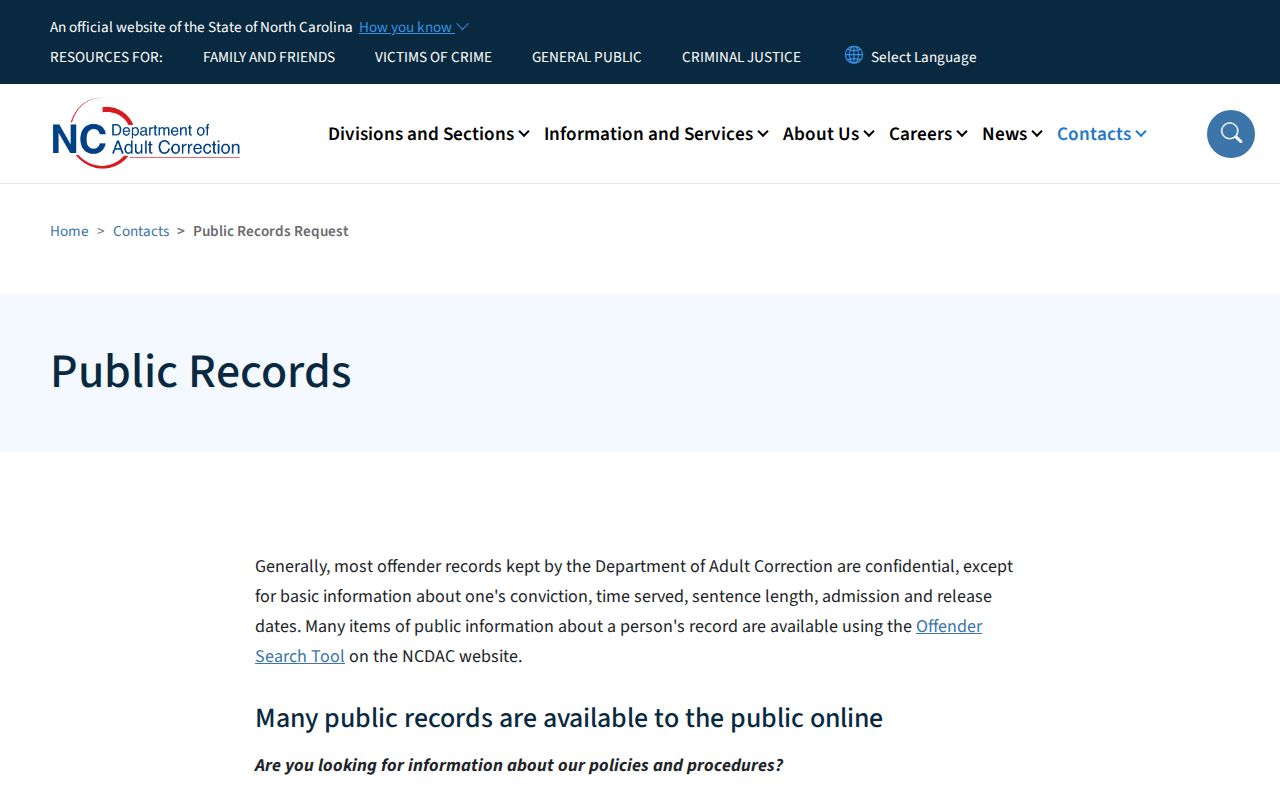
That form does not replace the sheriff request for a Scotland County Detention Center release.
For a date-range request, ask whether an existing jail-release report is maintained. Chapter 132 does not require the sheriff to create a new spreadsheet. If no report exists, narrow the request to one booking episode. This approach helps the custodian locate a real record and avoids demanding an interpretation. Electronic copies are the practical first choice. Paper cost or a lawful special-service charge may still apply, so the written estimate matters.
Scotland County Record Limits
North Carolina Chapter 132 defines public records broadly, including photographs, but specific exemptions still apply. Law-enforcement investigation, juvenile, medical, security, sealed, and expunged information may be withheld or redacted. An agency must provide access to existing nonexempt records at reasonable times. It need not create a new report or answer research questions that its files do not already answer.
Retention and web display are different. A record may stay in official files after it leaves a public portal. A scheduled disposal period does not prove that one named record has been destroyed. Expunction can seal or destroy covered state arrest, charge, and conviction records, causing an eCourts result to disappear. It does not automatically remove private copies. When a public search is empty, the accurate statement is that no matching public result was found.
Verify Scotland County Release Records
Scotland County has an unusually compact in-person verification route. The courthouse, sheriff, and detention center all use 212 Biggs Street in Laurinburg. Their counters do not keep the same hours or the same records. The sheriff's posted office hours are 8 a.m. to 5 p.m. on weekdays. The Clerk's posted hours are 8:30 a.m. to 5 p.m. on weekdays.
Begin with the jail record to establish the actual custody exit. Then compare the case disposition at the Clerk. A bond order may predate physical release, while paperwork or another hold delays the exit. A judgment to active prison may explain a transfer. A probation judgment may explain community supervision. Sharing an address makes the two checks easier, but it does not merge their legal functions.
The official Scotland County Courthouse page identifies the Clerk location used for terminal and paper-file access.
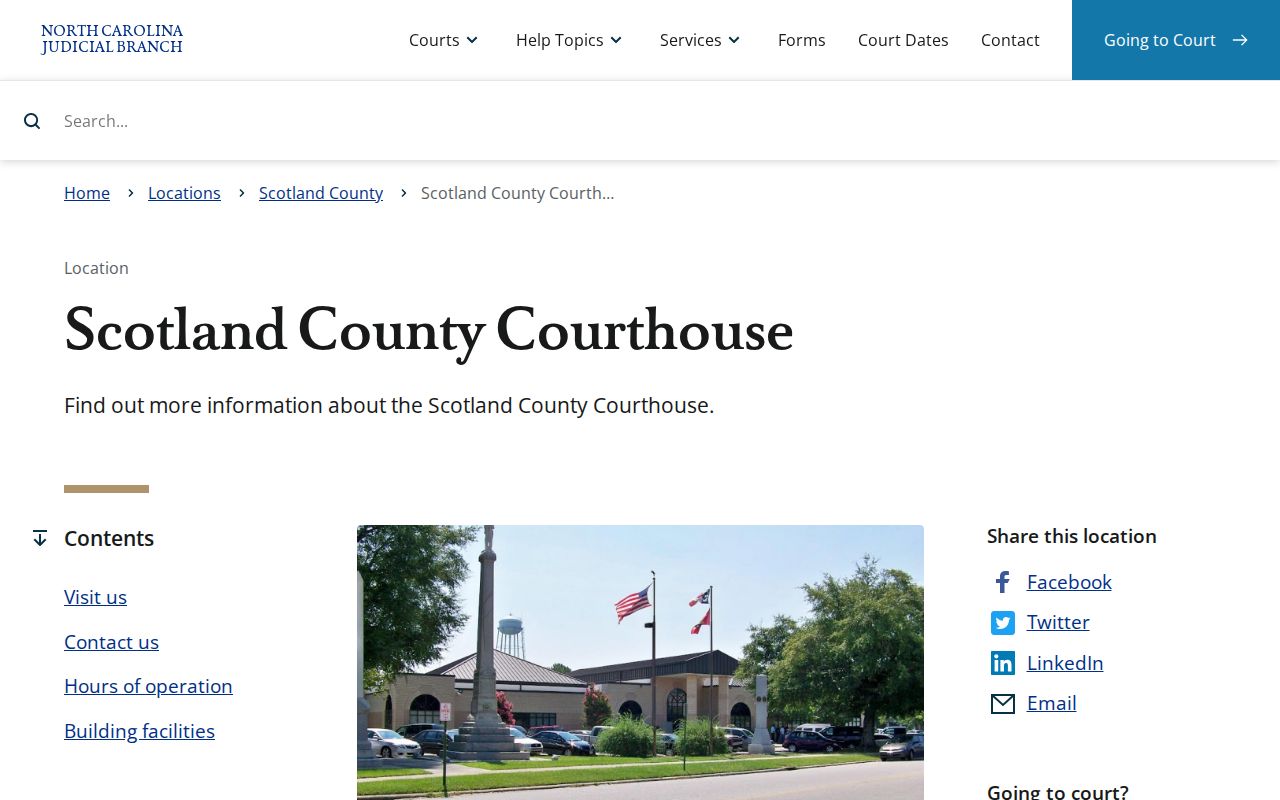
The courthouse record explains the case result, while the jail's own timestamp remains the source for the physical county release.
Find Released Scotland County Inmates
Start with the last confirmed custodian. Scotland Citizen Connect can establish current confinement or a recent admission, but it does not expose a local release list. A name that vanished may reflect release, transfer, correction, or a search mismatch. Build the sequence from official records and keep each agency's event separate.
- Check Citizen Connect for current confinement and admissions. Treat disappearance as a prompt, not a conclusion.
- Call the jail or request the sheriff's booking-and-release record for the exact episode.
- Search eCourts by case number for the order, judgment, and disposition that may explain the exit.
- Search NCDAC OPI if an active prison sentence, transfer, or community supervision may apply.
- Use NC SAVAN/VINELink to corroborate custody status and register for later changes.
- Use BOP or ICE only when facts point to federal or immigration custody.
A same-day records check uses the same fallback without turning admissions into releases. For one named person, the source sequence above remains the safer route.
NCDAC Scotland County Release Search
The NCDAC Offender Public Information search covers state prison and community supervision. It is not a Scotland County jail roster. Select All when status is unknown. Inactive is useful for a completed prison term, while Active Probationer/Parolee can reveal current supervision. An OPUS number is the strongest search key. Name, date of birth, aliases, sentencing court, offense, and admission dates help separate similar records.
| Search control | Best use | Caution |
|---|---|---|
| Offender number | Match a known OPUS record | Confirm it belongs to the right person |
| Last and first name | Start a broad person search | Spelling and aliases can change results |
| Active Inmate | Find current NCDAC incarceration | It excludes inactive prison histories |
| Active Probationer/Parolee | Check community supervision | Supervision is not current jail custody |
| Inactive or All | Find a past release or unknown status | Old episodes can appear with newer ones |
Read the top status, Most Recent Incarceration Summary, and sentence rows separately. Projected Release Date is an estimate. Actual Release Date is the retrospective event. Last Movement may show release or transfer. POST RELEASE/PAROLE with active supervision means the prison term ended but supervision continues.
NCDAC also offers an Inmate Release Search organized by release month and county. It is a state-prison report, not the Scotland County jail's recent-release list. Its Release County field describes the state system's release reporting and can include parole or return-to-parole events. A limited year menu also makes it unsuitable as a lifetime archive. Use it to locate a possible NCDAC event, then open the individual OPI record and compare the actual date, movement, and supervision fields.
The official OPI screen displays the status choices used to keep released Scotland County records from being filtered out.
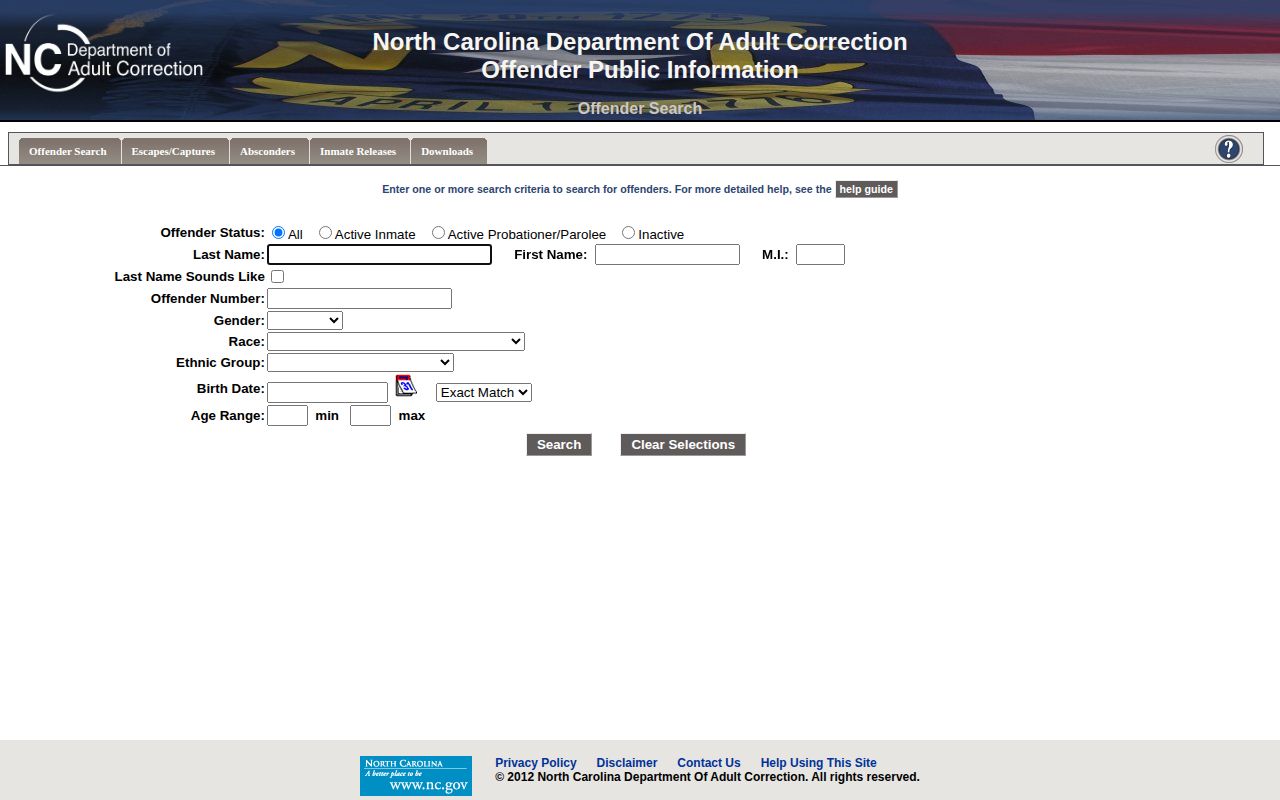
Choose the status range before deciding that a state record is absent.
Scotland County Recent Release Gap
The sheriff's Citizen Connect setup publishes Current Confinements, 24 Hour Admit, and seven-day admission views. It suppresses the vendor Releases interface. Scotland County therefore has no verified official 24-hour or 72-hour public releases feed as of the research date. The admit controls show entries into custody, not exits. Names from those screens must never be republished as released people.
For a recent county exit, request the jail release record first. NC SAVAN can provide a custody-change alert, and eCourts can show a new bond order, dismissal, sentence, or probation judgment. Use OPI only when state prison or NCDAC supervision is involved. None of these sources should be blended into an unofficial name list because their update times and custody scopes differ.
Note: A delayed alert or portal update does not override the official release timestamp maintained by the agency that held the person.
Scotland County In-Custody Programs
The detention center's program page lists Alcoholics Anonymous, Narcotics Anonymous, religious services, GED work, and a small road crew. The road crew was created in March 2015 and may include up to six people one day each week when weather permits. These are programs for people held at the jail. They are not verified post-release placements, transport services, or supervision offices.
That boundary matters when reading a release record. Participation does not identify a release type, destination, or continued service after custody. If OPI shows community supervision, contact the office displayed in that record. If the court ordered probation, read the judgment and NCDAC status. Do not infer a reentry plan from an in-custody program listing.
Scotland County Release Alerts
NC SAVAN/VINELink covers North Carolina county jails and NCDAC according to state material. Search for one person, confirm the custody agency and identity, then register for the available event notices. Phone registration is also available at 1-877-627-2826. Telephone alerts use a four-digit PIN, and calls may repeat when the PIN is not entered. A notice is useful, but the named custodian should confirm the event.
Federal systems have narrower roles. The BOP Inmate Locator applies to federal commitments and can show a past or projected Release Date. RELEASED with no facility means no longer in BOP custody, not an end to federal supervision or all other custody. ICE's locator covers current qualifying ICE or CBP detention. An ICE detainer can lead to a transfer after county release, but no Scotland-specific agreement was found. Use these channels only when the case or release record points toward them.
Compare Scotland County Custody Records
The same person may have a county booking, a state sentence, and later supervision. Compare the event date and agency before treating two records as one continuous status.
| System | What it establishes | What it cannot establish alone |
|---|---|---|
| Citizen Connect | Configured current confinement and admissions | A completed Scotland County release |
| Sheriff release record | Actual end of county custody and recorded basis | Later state, federal, or immigration custody |
| NCDAC OPI | Prison status, actual release, and supervision | A county-only jail episode |
| eCourts | Orders, judgments, events, and dispositions | The exact physical exit without the jail record |
| SAVAN/VINELink | Custody information and registered alerts | Guaranteed real-time or complete status |
| BOP or ICE | The relevant federal custody status | State or local custody outside that system |
Scotland County Release Facilities
Two detention facilities were identified in Scotland County. They serve different custody systems and send release questions to different record holders.
- Scotland County Detention Center is the sheriff-operated county jail. Releases may go to the community, NCDAC, another county, or another authority.
- Scotland Correctional Institution is an NCDAC state prison. Its release and discharge history remains in OPI, not Citizen Connect.
No separate municipal lockup, federal prison, ICE detention center, or regional jail was found within the county. A Laurinburg police arrest is booked at the county detention center under the sheriff's published process.