
Scotland County Parole vs Probation
Parole, probation, and post-release supervision all place a person in the community under rules, but they arise at different points. Probation is a court sentence or part of a judgment. Parole is a conditional release framework that now mainly applies to older or specially governed North Carolina cases. Post-release supervision is the usual supervised phase after incarceration for covered Structured Sentencing felony cases. The North Carolina Post-Release Supervision and Parole Commission makes eligible parole decisions and sets post-release conditions, while Community Corrections carries out day-to-day supervision.
A Scotland County person can be released from Scotland Correctional Institution yet remain active in the North Carolina Department of Adult Correction system as a supervisee. That is not a conflict. One field describes physical incarceration, and another describes legal supervision in the community. The Scotland County Detention Center is different. A routine Scotland County bond release from that jail does not by itself create an NCDAC parole record, though a court may impose probation in the same or a later judgment.
| Supervision type | How it begins | Best public check |
|---|---|---|
| Probation | A court judgment places the person under community supervision. | OPI Active Probationer/Parolee status, then the listed office. |
| Parole | The Commission conditionally releases a person in an eligible case. | OPI, Commission review reports, and Commission notices. |
| Post-release supervision | A covered felony prison term moves into a supervised community phase. | OPI incarceration and supervision blocks read separately. |
- Discharge
- The recorded end of a supervision term under the governing sentence and agency action.
- Absconder
- A person whom supervision reports as not complying with contact or location requirements.
- Detainer
- A request or hold tied to another legal authority that may affect custody or movement.
Verify Scotland County Post-Release Supervision
The public starting point is the NCDAC Offender Public Information search, commonly called OPI. It covers North Carolina prison histories and community supervision, not a county-only jail episode. An offender number is the best identifier. If it is unavailable, use the full name with birth date or age, then compare the sentencing court, offense, dates, demographics, and aliases before relying on a match.
- Select the Active Probationer/Parolee status when current supervision is the question. Use All when the status is uncertain.
- Enter the offender number if known. Otherwise search by name and add another identifier to reduce false matches.
- Open the matching detail and read Probation/Parole/Post Release Status separately from Incarceration Status.
- Record the Probation/Parole Office shown in the detail. That office is the operational contact for reporting and status questions.
- Check Actual Release Date and Last Movement when the question also involves release from NCDAC incarceration.
A missing result is not proof that Scotland County supervision never existed. Search spelling, status selection, indexing, and identity details can affect Scotland County results. County court records may show a probation judgment, while OPI supplies the corrections status. For the broader jail-release and court-record path, use the Scotland County released inmate search.
The official OPI search shows the status filters used for a supervision check.
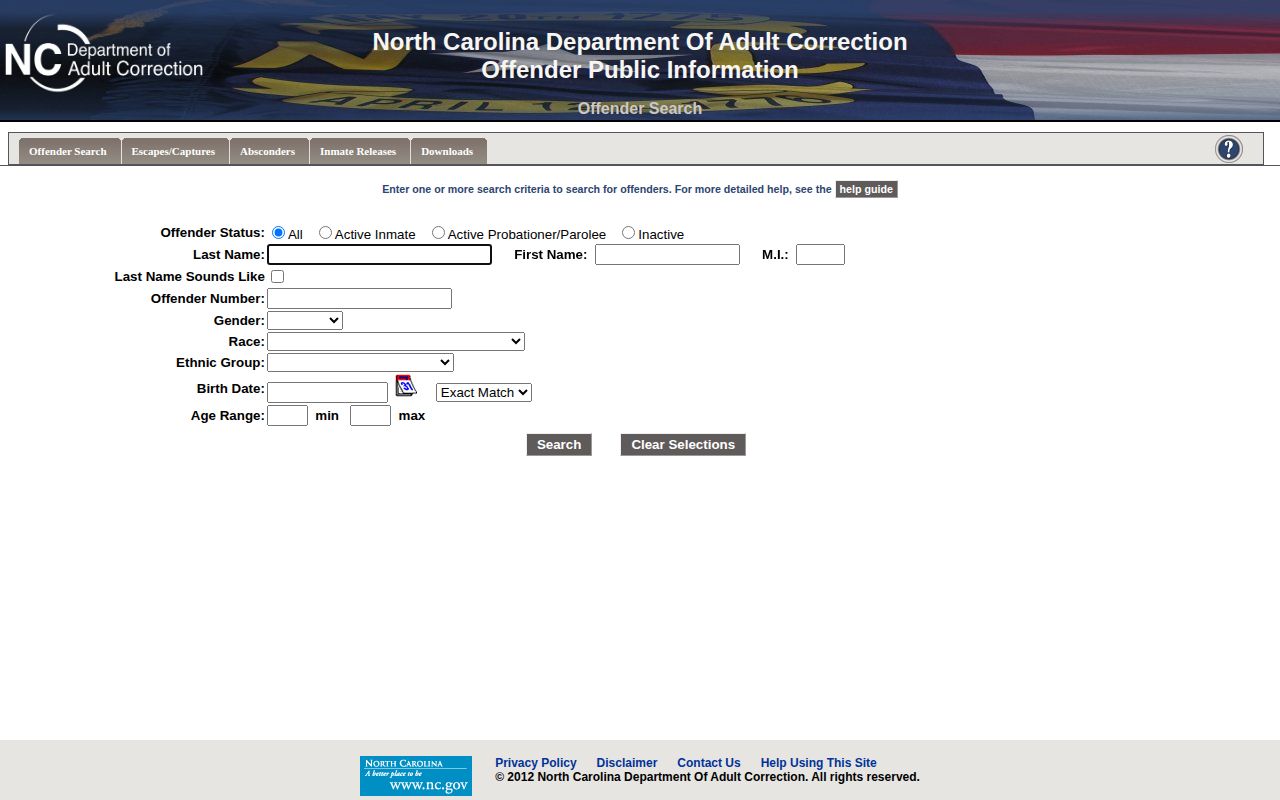
Choosing the correct filter helps separate an active supervisee from an active inmate or an inactive corrections history.
Note: OPI does not contain routine Scotland County jail bookings unless the person also has a relevant NCDAC record.
Scotland County Supervision Office Records
OPI may name the Probation/Parole Office assigned to the record. That displayed office should control local questions because the research did not verify a single Scotland County office address, telephone number, or check-in schedule that applies to every person. Reporting terms are individual. A different county's schedule cannot safely be carried over, and the statewide Commission is not a substitute for the office listed on the person's record.
The Commission is the statewide decision-making body for eligible Scotland County parole and post-release matters. It can address its process and official decisions, while Community Corrections administers supervision in the community. The contact below is therefore appropriate for Commission records or process questions. Questions about a particular Scotland County reporting place should go to the office that OPI displays.
North Carolina Post-Release Supervision and Parole Commission2020 Yonkers Road
4222 Mail Service Center
Raleigh, NC 27699-4222
919-716-3010
Parole.Commission@dac.nc.gov
The Commission's official page identifies its statewide role and contact channels.
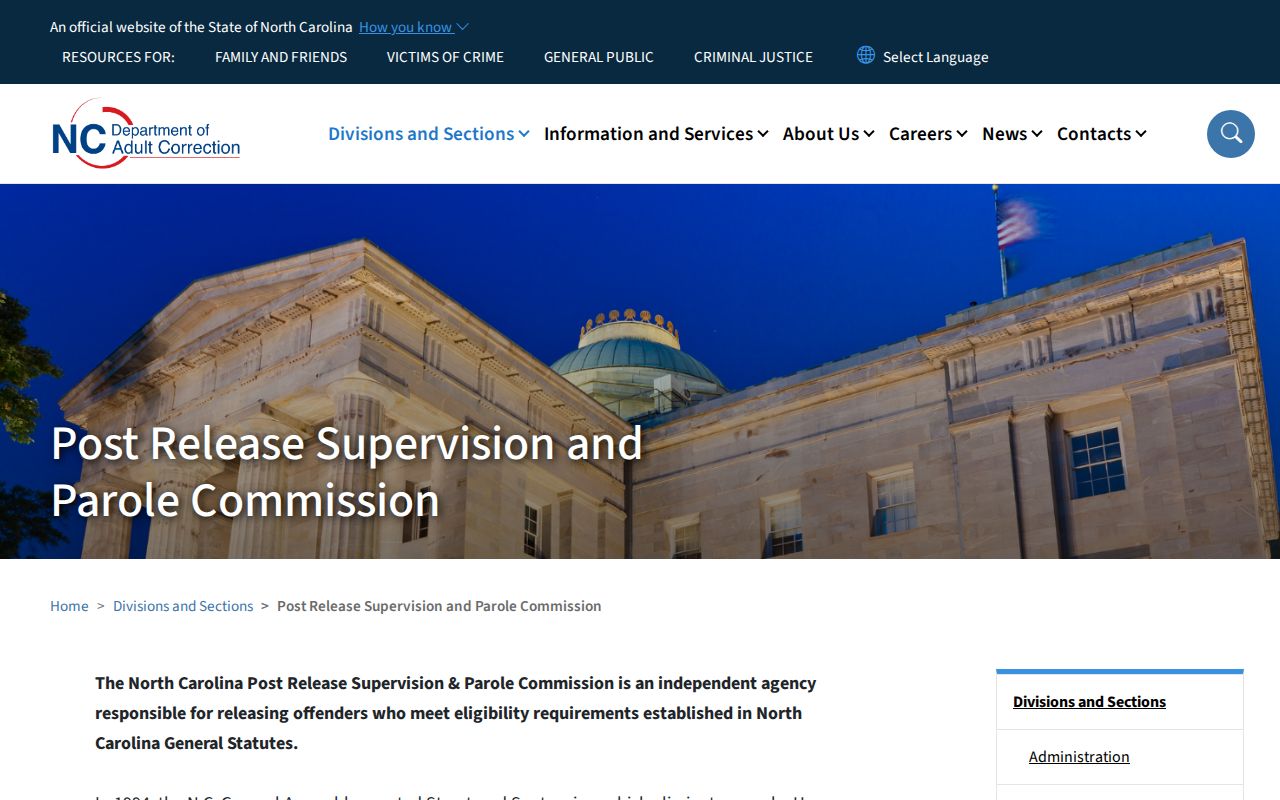
The statewide contact can clarify Commission procedure, but the OPI-listed office remains the local source for an individual's supervision instructions.
Scotland County Absconder Status
NCDAC maintains a separate Absconder Search. An entry means the supervising agency reports that the person has not complied with contact or location requirements. It does not mean supervision ended. It also does not prove the person is in Scotland County Detention Center, and it should not be read as a complete current warrant return.
When an absconder result appears, confirm the identity and contact the supervision office shown in OPI. If a new Scotland County arrest is plausible, check the county's current confinement system separately. NC SAVAN may provide custody or supervision event notice, but it remains a notification channel rather than the authoritative supervision file. A violation can lead to agency action, a court response, or confinement, yet the exact outcome must come from the record tied to that person.
The NCDAC Absconder Search is distinct from both the main offender search and the county jail portal.
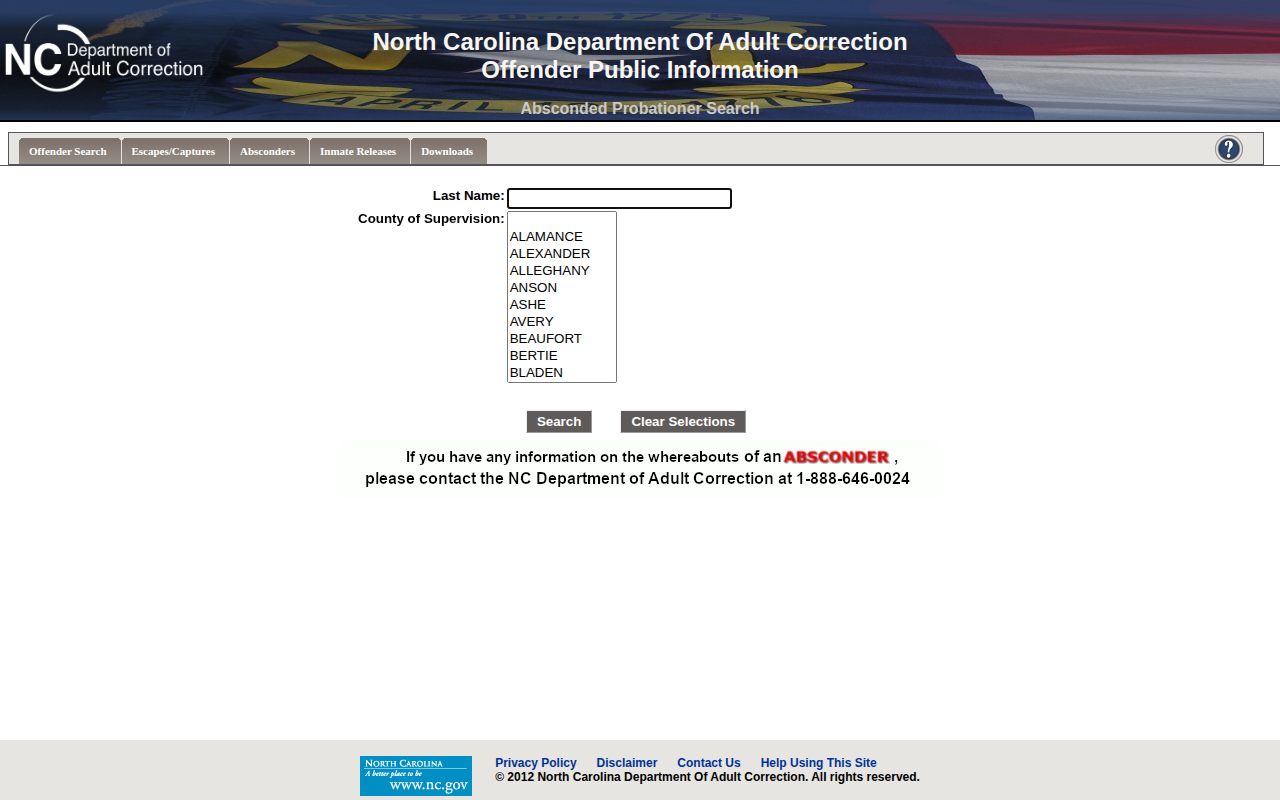
Its result should prompt office verification and a separate custody check, not a claim that the person has been discharged or jailed.
Note: An absconder label describes reported noncompliance with supervision contact or location rules, not a new conviction or completed term.
Scotland County Parole Review Results
There are no formal hearings in the North Carolina Commission's parole review process, and the Commission does not meet personally with offenders during review. There is no conventional hearing calendar for Scotland County parole cases. The official substitute is the Commission's monthly Discretionary Parole Reviews series, which begins with reports from September 2024. Media Notifications provide certain case-specific notices about investigations, grants, and changes to established dates.
The monthly reports group outcomes such as regular parole, community-service parole, early medical release, 90-day mandatory parole, incomplete or suspended decisions, and denials. An incomplete or suspended decision is not a parole grant. An investigation also means that review continues, not that a Scotland County release has occurred. Even a grant or established date stays prospective until OPI records the actual custody movement.
The monthly review archive is the correct results source in place of a hearing calendar.
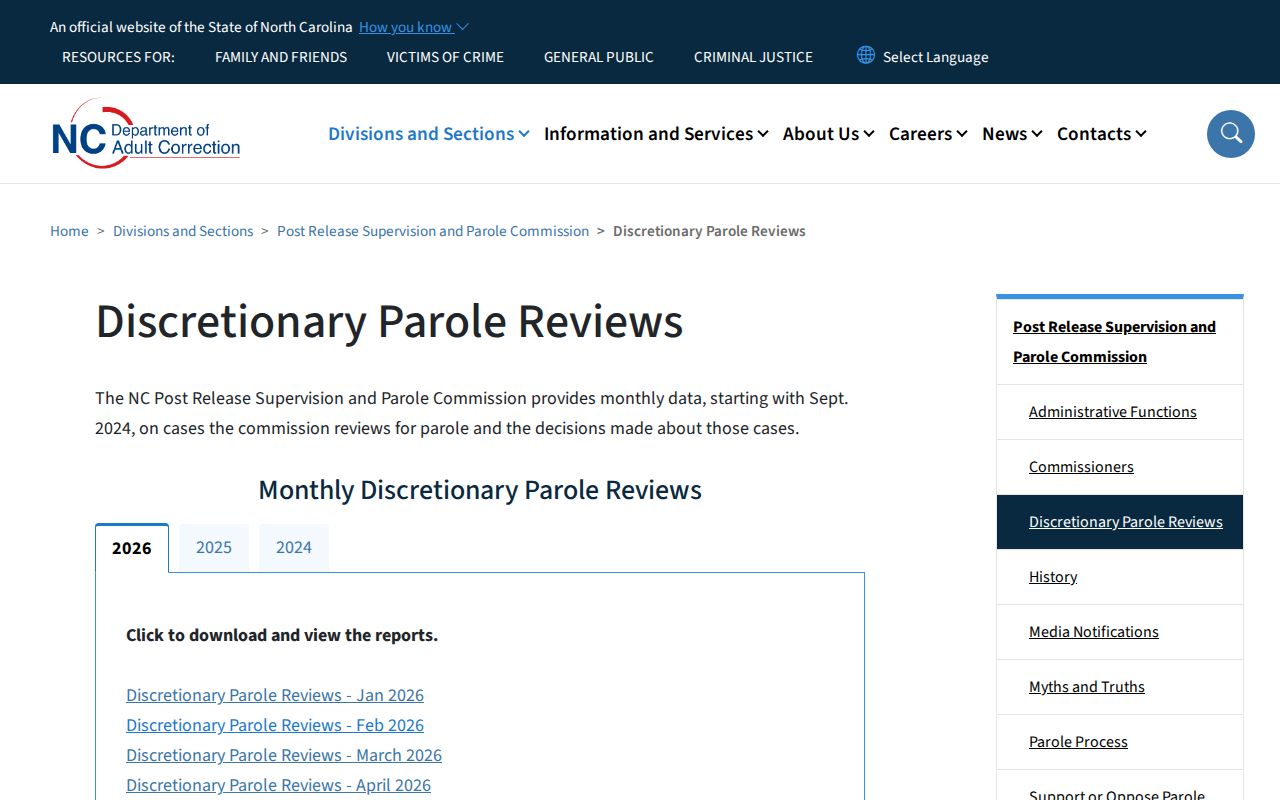
Each listed result still needs to be paired with the person's OPI status and actual movement before release is treated as complete.
Scotland County Parole Eligibility
Traditional discretionary parole mainly concerns offenses committed before October 1, 1994, along with other specially governed cases. Structured Sentencing removed routine discretionary parole for most later offenses and generally uses post-release supervision after a covered felony prison term. That difference makes the offense date and sentencing law more useful than the charge name alone.
G.S. 15A-1371 contains case-specific eligibility timing, denial grounds, and notice provisions. Where a sentence has a minimum, eligibility can involve that minimum or one-fifth of the maximum penalty, whichever is less, with specified credit rules. Fair Sentencing cases and life cases have further provisions. The Commission's parole-process material explains investigation, voting, and periodic review, so the statute and agency process must be read together.
Scotland County In-Custody Programs
The Scotland County Detention Center describes Alcoholics Anonymous, Narcotics Anonymous, religious services, GED work, and a small road crew among its inmate programs. These are local in-custody activities. They are not verified post-release placements, and participation does not establish parole, probation, discharge, or a community reporting plan.
This distinction matters when reviewing a Scotland County release. A program record may describe what occurred during detention, while OPI and the assigned Community Corrections office describe what follows under state supervision. The sheriff's inmate-program page should not be used as a referral list after release. No local reentry placement tied to those programs was verified in the research.
Note: Ask the office shown in OPI about an individual's approved plan instead of treating a jail program as post-release supervision.
Scotland County Supervision Discharge
Supervision ends through the governing sentence and the responsible agency's recorded action, not merely because a person stops appearing in one search. For covered post-release supervision, G.S. 15A-1368.2 governs release into supervision, the term, and limits on credits that may reduce that period. Probation follows the court judgment and later court or agency entries. Parole discharge depends on the applicable older or special sentencing framework.
Read the OPI supervision status and end fields, then confirm an unclear entry with the listed office. Inactive incarceration only says the prison phase is not active. It does not, by itself, establish that parole, probation, or post-release supervision has ended. Likewise, an empty county jail roster says nothing conclusive about a state supervision discharge.
A complete Scotland County verification states both facts when available: the incarceration status and the community-supervision status. That phrasing avoids calling someone incarcerated when only supervision is active, and it avoids calling the sentence complete when the prison term ended but supervision continues.