
Scotland County Projected vs Actual
North Carolina Department of Adult Correction records use the exact field name “Projected Release Date.” NCDAC release policy also calls sentence expiration the PRD or “max out.” The field estimates when the governing sentence and credits may produce release from incarceration. It does not record a completed event. A projected date may remain visible after release, which makes it important to check the record's current status and later movement fields.
An Actual Release Date is retrospective. Inactive incarceration and a Last Movement that records release add stronger proof that the prison phase ended. Even then, active probation, parole, or post-release supervision may continue. A county jail release is a separate custody event. The Scotland County Detention Center's record, not OPI, controls a routine local bond-out or county-only detention episode.
A person awaiting trial has no sentence-based projected date merely because a current confinement record exists. Bond action, a court order, a case disposition, or another hold may determine what happens next. If a county sentence has been imposed, ask the jail and court for the calculation tied to that judgment.
Find Scotland County Projected Dates
Begin with custody type. A person at Scotland Correctional Institution is in the state prison system, so use NCDAC Offender Public Information. A person at Scotland County Detention Center is in county custody, so use the jail record and Scotland County court judgment. OPI expressly excludes county-jail information and cannot calculate a routine county release.
- For state custody, search OPI by offender number. If unavailable, use the name with birth date or age and compare offense and sentencing court.
- Choose All when status is uncertain. Active Inmate can omit a past prison history, while Inactive is useful after release.
- Open the matching detail. Read Incarceration Status, the summary Projected Release Date, each sentence row, detainers, and Last Movement.
- For a county sentence, ask Scotland County Detention Center for its calculation and compare it with the court judgment. No local public calculator was found.
- Save the date checked and recheck near the projection. Once release occurs, look for the actual date and movement instead.
The NCDAC Inmate Release Search serves a different purpose. It lists state releases by reported release county, year, and month or by surname. Its Scotland selection is not a Scotland County jail release list, and release county does not necessarily mean the county of conviction or original booking. A full named-person path across the jail, court, and state systems is available on the Scotland County released inmates page.
Note: “Current Location” on a released OPI record may identify a supervision area and must not be called a prison without support.
Scotland County Earned-Time Rules
North Carolina's minimum and maximum sentence structure is central to a Scotland County state-prison projection. G.S. 15A-1340.13(d) says an active felony offender must serve the minimum term. Earned time may reduce the maximum within statutory limits, but it cannot reduce the term below that minimum. G.S. 15A-1340.17 supplies minimum and maximum tables and special calculations for covered classes and offenses.
NCDAC summarizes Structured Sentencing for covered felonies as service of 100 percent of the minimum and 85 percent of the maximum, followed by post-release supervision. That shorthand is not a release-date formula. Do not multiply a sentence by 0.85. The arithmetic cannot identify which sentence controls, whether terms are concurrent or consecutive, how credits were awarded or lost, whether a detainer applies, or whether a violation changed the record.
G.S. 148-13 directs NCDAC to adopt earned-time rules and also extends those rules to local administrators for sentenced jail prisoners. It does not create credits for a pretrial detainee who is awaiting case disposition. Scotland County publishes no local good-time chart or computation worksheet, so an individual county calculation must come from the jail and court.
The earned-time statute shows why local sentenced prisoners and state prisoners require an official record rather than an estimate.
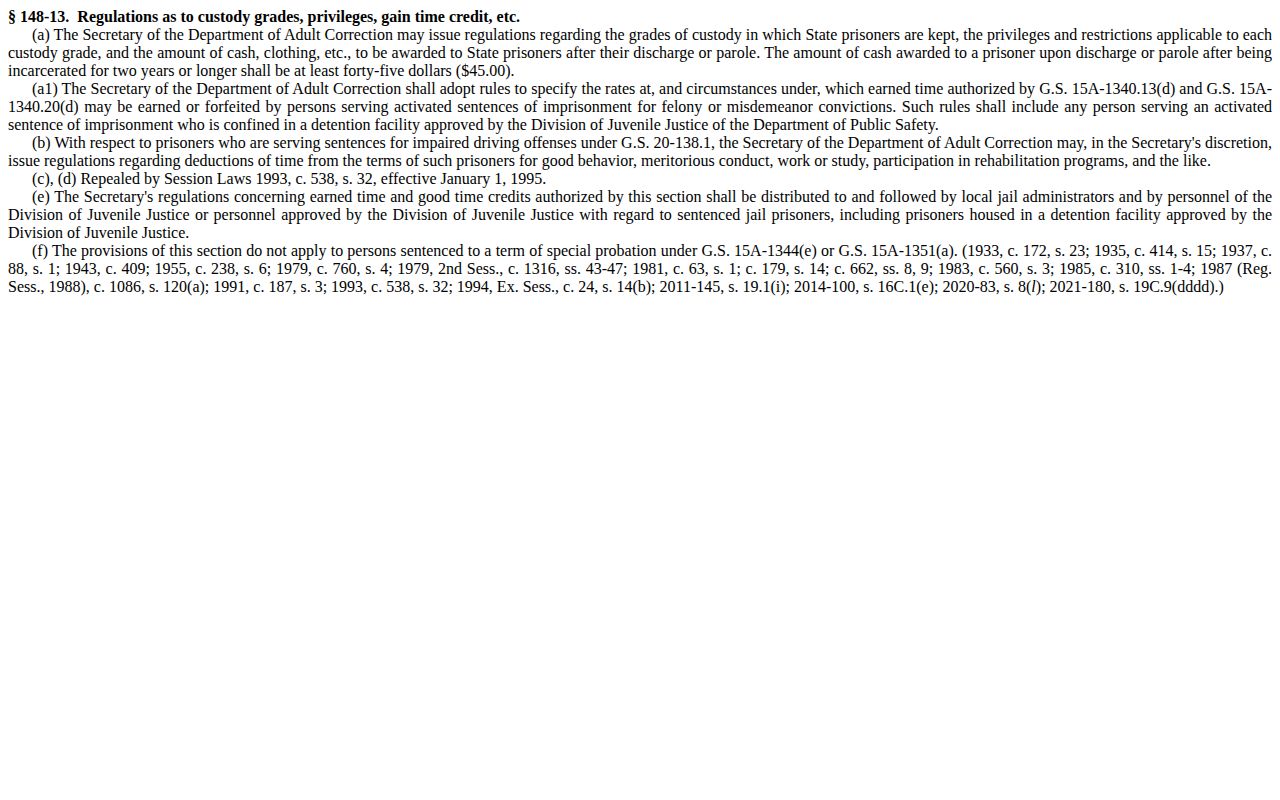
The statute supplies the rulemaking basis, while the custodian's sentence computation supplies the person-specific projected release date.
Why Scotland County Dates Change
A projected release date is recalculated when facts that control sentence service change. Some entries alter the expected day. Others change the destination or show that leaving one custodian does not mean unrestricted community release. The record's release type and receiving authority can be as important as the date.
| Record event | Possible effect on the projection | Where to verify |
|---|---|---|
| Earned-time activity | Credits may be awarded, forfeited, or restored within the law's limits. | OPI and NCDAC sentence records. |
| Sentence correction | Corrected data, an appeal, or a court order can change the controlling terms. | NCDAC detail and the court docket. |
| Concurrent or consecutive terms | The sequence of multiple sentences can alter which date controls. | Each OPI sentence row and judgment. |
| Revocation or new sentence | A supervision violation or new judgment can add confinement or restructure service. | OPI supervision blocks and court records. |
| Detainer or agency handoff | The person may leave one sentence or custodian but move to another authority. | Detainer, Last Movement, release type, and receiving agency. |
| Administrative movement | A transfer, safekeeper return, or interstate action may be coded as movement rather than community release. | NCDAC Q.0100 release record. |
NCDAC release procedure also recognizes court-ordered release, safekeeper return to a sheriff, completion of a pre-sentence diagnostic study, interstate action, pardon, and conditional commutation. A release code can therefore describe exit from NCDAC incarceration while the person returns to a sheriff or another state.
Scotland County Post-Release Dates
G.S. 15A-1368.2 governs the transition to post-release supervision for covered felony sentences. The release-to-supervision calculation can involve the maximum less a statutory supervision component and earned time. The research identifies general provisions of 12 months for B1 through E, nine months for F through I, and 60 months for covered reportable offenses, but offense class, date, and governing law must be confirmed in the actual record.
Release from Scotland Correctional Institution onto post-release supervision ends prison custody but not the sentence framework. OPI may show inactive incarceration at the same time as active Probation/Parole/Post Release Status. Those two fields answer different questions and should be reported together. A projected release should not be described as final discharge from supervision.
The post-release supervision statute shows why a prison release date and a supervision end date are not interchangeable.
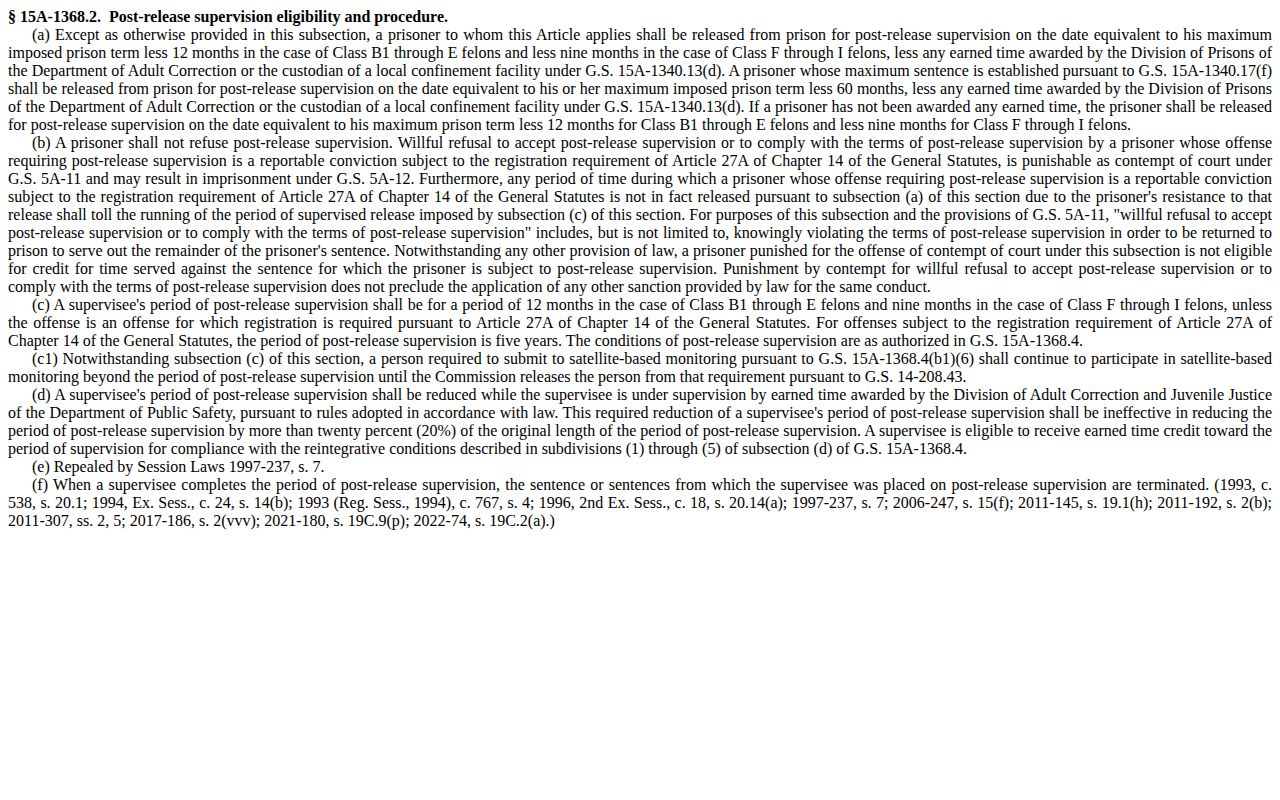
The sentence and supervision fields must be read in sequence before a Scotland County release status is stated.
Note: A release into supervision is a real exit from prison custody, but it is not the same as discharge from all supervision.
Multiple Scotland County Projected Dates
A Scotland County OPI detail can retain a summary Projected Release Date and more than one sentence-level projected date. They may differ because the page represents multiple sentences, prior incarceration blocks, status changes, or distinct service histories. The Scotland County summary should not be copied without reading the individual rows and the Most Recent Incarceration Summary.
First identify which incarceration is current. Then compare each sentence's service status, begin date, minimum and maximum terms, punishment type, and actual or projected release fields. An older block marked expired can remain in the history. That persistence is useful for confirming a prior state release, but it can also cause a past projected date to be mistaken for the date tied to a new Scotland County case.
The privacy-redacted OPI record capture illustrates the mix of actual, projected, movement, and status fields without publishing a person's identity.
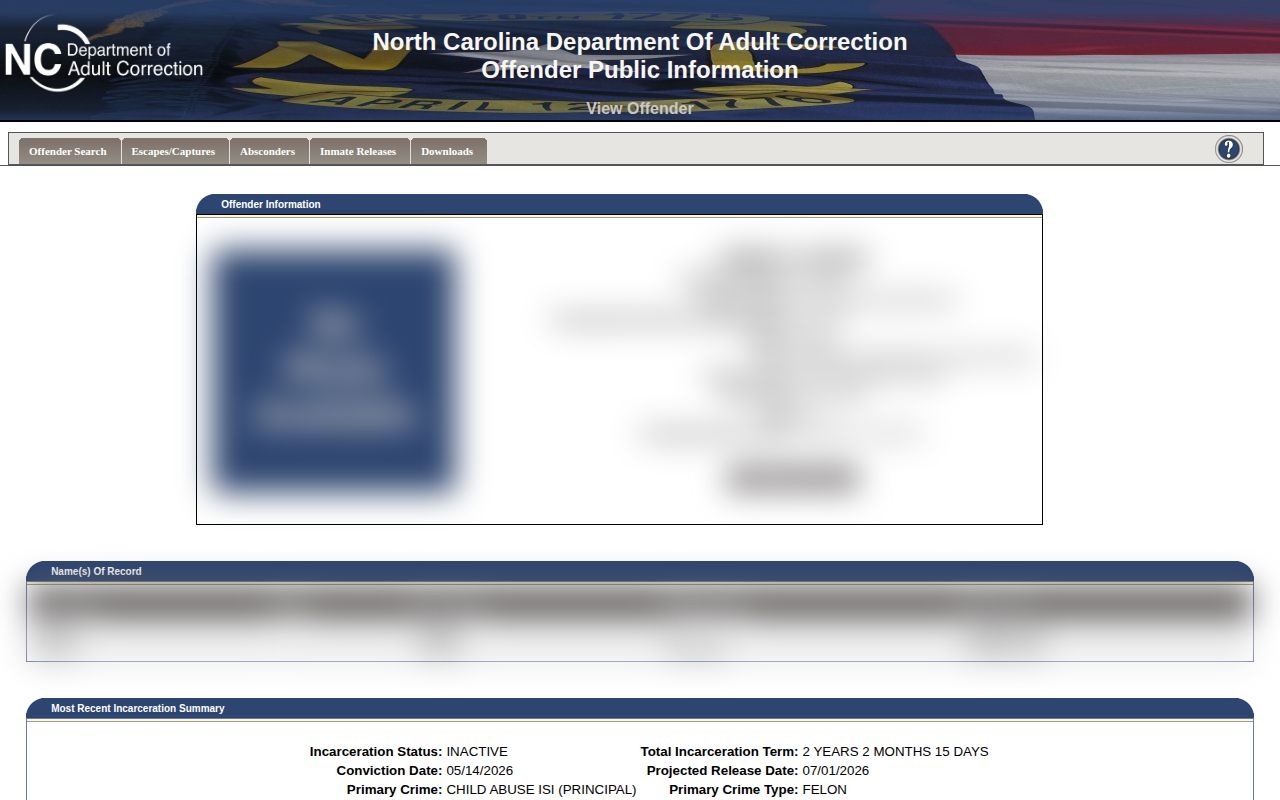
Once release occurs, Actual Release Date, inactive incarceration, and Last Movement carry more weight than an old summary or sentence-level projection.
Scotland County Jail Calculations
The Scotland County Detention Center calculation belongs to the county jail and the court record, not to OPI. A pretrial person may leave on bond or court order without ever receiving a sentence-based projection. A sentenced jail prisoner may receive credits under the state framework, but the official sweep found no Scotland-specific good-time chart, weekend-release law, public computation worksheet, or posted holiday-release rule.
Ask for the judgment, commitment details, admission date, jail's computed date, and any hold or receiving agency recorded for the person. Do not assume that a court disposition and physical release happen at the same time. Jail processing or another detainer may delay community release, while a sentence to state prison may produce a transfer to NCDAC rather than release from custody.
A county record should say whether the exit was bond, time served, court order, sentence expiration, or transfer. That release type explains what the date means. If the person moves into NCDAC, begin a new state-system check rather than carrying the county estimate forward.
Confirm Scotland County Release Dates
Record the date and time of each check. Revisit OPI near a state projection and look for a changed PRD, Actual Release Date, inactive incarceration, and Last Movement. NC SAVAN can provide a custody-change notification for participating county and state systems, but a notification is corroboration rather than the custodian's historical release record. Registration steps and PIN limits are detailed in the Scotland County VINELink check.
For county custody, confirm with Scotland County Detention Center and the court. For state custody, use OPI and, when the public detail remains unclear, NCDAC Public Records with the offender name, OPUS number, facility, date range, and exact sentence or release fields requested. NCDAC does not possess county-only jail records.
The final statement should name the custodian: released from Scotland County Detention Center, released from NCDAC incarceration onto supervision, transferred from the county jail into NCDAC, or still projected for a future state release. That precision prevents a valid date from being attached to the wrong system.
When the public Scotland County state detail is ambiguous, a narrow NCDAC records request can ask for the release or discharge movement and the readily available sentence history. Include the offender name, OPUS number, Scotland Correctional Institution when applicable, and the exact date range. NCDAC generally treats basic conviction, sentence length, admission, time served, and release dates as public, while much of the internal offender file remains confidential. A request may therefore return a focused public record rather than the full file.
Do not send a county-only booking request to NCDAC. The agency states that it does not hold county jail records. Scotland County Detention Center and the Scotland County court remain the correct custodians for a local sentence, bond release, or transfer order. Matching the request to the custodian prevents delays and keeps a state PRD from being confused with a county jail calculation.